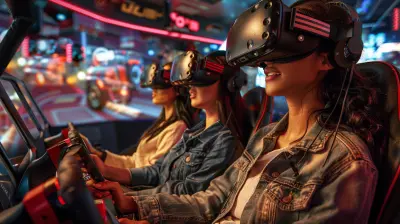
Anticipating the Next Breakthroughs in VR Game Mechanics
23 April 2026
Virtual Reality. It’s a phrase that still sparks a flicker of sci-fi wonder in people’s eyes. But for us gamers, it’s become more than just an idea from the future—it’s a playground that’s slowly but surely expanding its borders. We’re not just watching VR grow; we’re inside it, carving our presence with each step we take in a digital world.
But here’s the thing—we’ve only scratched the surface. If you think VR games are already wild with their teleportation mechanics and simulated hand physics, buckle up. The next wave of VR game mechanics is creeping up around the corner, and trust me, it's going to change the rules of the game... again.
So, what’s coming? What will VR feel like in the next few years? Let’s put on our headsets and peek into the (near) future.
The Evolution So Far – A Quick Look Back
Before we dive into the “what’s next,” let’s zoom out and see how far we’ve come.Early VR games were clunky. They were more about showing off fancy head tracking or letting you wave your arms around pointlessly. But over time, developers started to understand how to blend immersion with engaging gameplay. That’s where we started to see real innovation—things like:
- Finger tracking
- Locomotion systems (smooth motion, teleportation, arm-swinging, you name it)
- Room-scale movement
- Semi-realistic hand interactions with objects
These might seem basic now, but a few years ago, they were revolutionary. And that’s what's exciting. If that kind of progress can happen in less than a decade, what could the next ten years bring?
1. Full-Body Tracking Without the Tangle
Let’s face it: full-body tracking is a hot mess right now. Between clipping issues, janky leg movements, and having to strap sensors all over your limbs, it’s more trouble than it’s worth for most players.But that’s changing.
Big brains in VR tech are working on lightweight, non-intrusive body tracking, possibly using AI to interpret lower-body motion with just a headset and optional accessories like foot trackers or even just a webcam.
Imagine being able to kick, crouch, spin, or even dance in VR—and have your avatar mimic those movements 1:1 without making you look like a glitchy ragdoll. Not only will this revolutionize social VR experiences, but game mechanics like stealth, parkour, and even sports simulations will become infinitely more engaging.
Got a sword fight coming? Now you’ll be able to backflip out of danger—and not just in your head.
2. Smarter NPC Interactions (Hello, AI!)
You know how NPCs (non-playable characters) often feel like robots on a script? In VR, that disconnect hits even harder. You’re fully immersed, but they’re stuck in 2005, repeating the same line every time you walk by.The solution? AI-powered NPCs.
Machine learning and natural language processing are on track to bring NPCs that react and respond like actual humans. Think about it:
- You say something with your real voice.
- The NPC listens, understands the context, and responds dynamically.
- They remember things about your character. Your choices matter.
This opens doors to whole new gameplay mechanics. Want to bluff your way out of a sticky situation? Gossip about another character? Or form genuine relationships in story-driven games? It might all come down to how well you talk, not just what buttons you press.
It’s like turning Dungeons & Dragons into a full-blown immersive experience where the dungeon master is a super-smart AI... and it never sleeps.
3. Natural Movement – No More Motion Sickness, Please!
Motion sickness is still the big, bad wolf lurking outside the VR cottage. Many players can’t handle more than 20 minutes of continuous movement without their virtual lunch coming up.Developers have tried to solve this with teleportation, blink movement, and other motion hacks. But these are just Band-Aids.
The future lies in systems that let you move naturally without nausea. Think omnidirectional treadmills becoming affordable—and compact enough for a living room. Or better yet, neural interfaces that trick your brain into feeling movement that isn’t really there. That’s right—your feet stay still, but your brain swears you’re sprinting through a cyberpunk alley.
This kind of immersion will completely change game mechanics. Movement won’t be a limiter anymore. Want to scale walls like Spider-Man? Sprint through a battlefield in a VR FPS? Yeah, that’s coming.
4. Real-Time Physical Feedback (Yes, It’ll Hurt… A Little)
The idea of haptics isn’t new. We’ve all played with those buzz-heavy controllers that vibrate when you shoot a gun or take damage. But what if we could go deeper?We’re talking:
- Haptic suits that simulate everything from a light breeze to a punch in the gut
- Feedback gloves that let you actually “feel” texture or tension
- Force resistance for weapons and tools
Imagine getting caught in a VR rainstorm and literally feeling the drops hit your shoulders. Or feeling the kickback from your blaster as you shoot. Those tactile sensations aren’t just cool—they reshape how the game feels at every level. Mechanics involving stealth, exploration, combat, or even romance could be more nuanced and real.
VR is going from “see the world” to “feel the world.”
5. Brain-Computer Interfaces: Control with Your Mind
Sounds like sci-fi, right? But this one’s real—and already in testing.Brain-computer interfaces (BCIs) are devices that let you interact with digital systems just by thinking. In VR terms, BCIs could mean controlling your character’s actions, movement, or powers with your thoughts.
Think about how game mechanics will flip when:
- You can open a door just by intending to
- Use telekinesis powers without pressing a button
- Influence the world based on your emotional state (calm minds unlock puzzles, for example)
That’s not just immersion. That’s transcendence.
6. Procedural Storylines That React to You
Remember those “your choice matters” games? They’re cool, but let’s be real—there are usually just 2–3 outcomes dressed up with different dialog.In the next phase of VR, we’re talking about procedurally generated storylines that truly react to your behavior. Not just branching paths, but dynamic plotlines that adapt to how you play, what you say, and where you go.
Imagine:
- Entire cityscapes built around your actions
- Characters forming alliances and rivalries based on your personality
- Multiple parallel narratives that unfold organically
And with AI models writing dialog and plot in real-time, no two players will experience the same story. It’ll be like stepping into your very own custom-written sci-fi novel—with you as the main character.
7. Multi-Sensory VR: Beyond Sight and Sound
We’ve got visuals and audio nailed pretty well in VR. But what about smell? Taste? Temperature?Yeah, it sounds wild, but companies are already experimenting with:
- Smell emitters to recreate environments (imagine the scent of gunpowder, pine forests, or old books)
- Heated or cooled clothing for environmental immersion
- Taste simulations (we’re not there yet, but the tech is on the radar)
It’s all about bringing VR closer to reality. Multi-sensory gaming could lead to entirely new genres built around subtle stimuli. Horror games that use scent to trigger fear. Cozy exploration games that warm your skin on a snowy trail… it’s like adding the last pieces of the puzzle.
8. Persistent VR Worlds with Real Economies
We’re seeing games like VRChat and Rec Room tiptoe toward persistent worlds, but the next evolution is truly massive shared universes with ongoing economies, ecosystems, and social systems.Think of it as the VR version of a real-world society:
- You log out, the world keeps going
- Events unfold while you’re gone
- Your business, farm, or guild still functions in real-time
Tie that in with blockchain tech or NFTs (yeah, they’re controversial, I get it), and we may see actual virtual economies where effort translates into value.
This could redefine what it means to "play" a game—it might become how some people live.
So, When’s All This Happening?
It’s not all arriving tomorrow—but it’s closer than you might think. Many of the systems we’re talking about are in prototype stages, beta tests, or pre-launch development. The big leap will happen when hardware becomes more accessible, and developers fully embrace these new tools.But when it hits? The line between reality and virtual reality is going to blur in ways we’ve only dared to imagine.
Final Thoughts: The Next Level of Immersion Awaits
Here’s the beautiful thing about VR: every time you think you’ve seen it all, it shocks you with something new. The future of VR game mechanics isn’t just about better graphics or fancier controls—it’s about transforming how we interact, feel, and think inside digital worlds.So, whether you're a developer, a hardcore gamer, or someone who's just waiting for the “perfect” VR game to jump in—get ready. The next breakthroughs are bound to shake up the entire gaming landscape.
And when that moment comes? You’ll want to say you saw it coming.
all images in this post were generated using AI tools
Category:
Vr TechnologyAuthor:

Tina Fisher
Discussion
rate this article
2 comments
Miles Newton
Exciting times ahead! Can't wait to see how VR evolves and enhances gaming experiences.
April 25, 2026 at 4:21 AM
Tina Fisher
Absolutely! The potential for VR in gaming is huge, and I can't wait to see what innovative mechanics come next.
Sablethorn Clayton
As we stand on the brink of VR's next evolution, the integration of sensory feedback and AI-driven narratives may redefine immersion. This convergence could transform player agency, making choices feel more consequential. Ultimately, the challenge will be crafting experiences that resonate emotionally, not just technologically, fostering genuine connections in virtual realms.
April 23, 2026 at 2:40 AM
Tina Fisher
I completely agree. The combination of sensory feedback and AI has the potential to elevate immersion and emotional engagement in VR, pushing the boundaries of player experience. It's an exciting time for innovation in this space.